AI for Business: Exclusive Computer Vision Guide with Best Practices
In today’s rapidly evolving technological landscape, AI for business is no longer just a futuristic concept but a practical tool that companies of all sizes are leveraging to gain competitive advantages. Among the myriad applications of artificial intelligence, computer vision stands out as a transformative technology with vast potential to reshape industries. This exclusive guide delves into how businesses can effectively use computer vision, outlining best practices to ensure successful implementation and maximize ROI.
Understanding Computer Vision in AI for Business
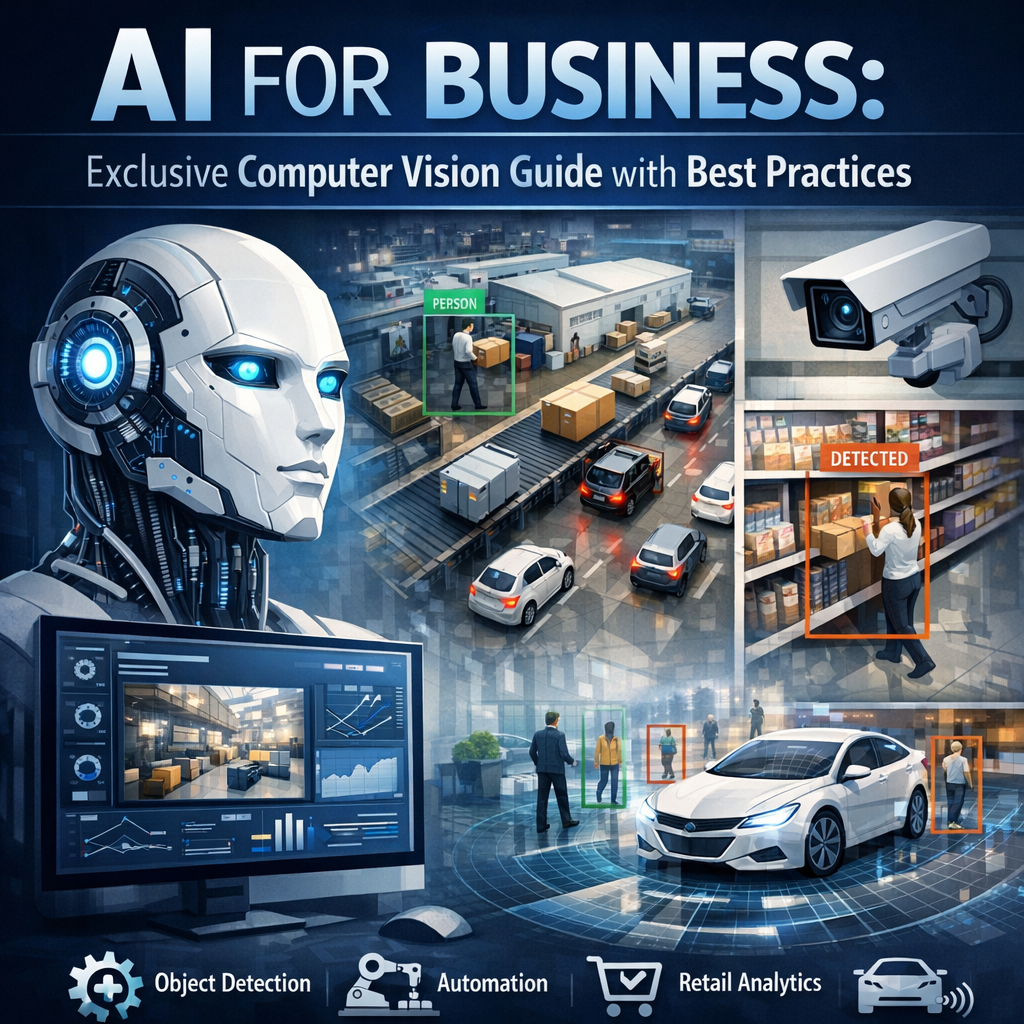
Computer vision is a branch of artificial intelligence that enables machines to interpret and make decisions based on visual data from the world, such as images and videos. In the context of AI for business, this technology allows companies to automate, optimize, and innovate processes that traditionally required human visual capabilities. The applications span from quality control in manufacturing to customer behavior analysis in retail.
Key Business Applications of Computer Vision
Before diving into best practices, it’s important to recognize the areas where computer vision is making an impact:
– Retail: Automated checkout systems, inventory management with real-time shelf monitoring, and personalized in-store experiences.
– Manufacturing: Defect detection on production lines, predictive maintenance through visual inspections, and robotic assembly guided by cameras.
– Healthcare: Medical imaging analysis, patient monitoring, and surgery assistance.
– Security and Surveillance: Facial recognition, anomaly detection, and automated threat monitoring.
– Agriculture: Crop monitoring, pest detection, and yield estimation.
Understanding the specific business needs and use cases is pivotal for tailoring computer vision solutions that deliver tangible value.
Best Practices for Implementing Computer Vision in AI for Business
1. Define Clear Objectives and Use Cases
Starting with a vague idea often leads to project failure. Businesses should precisely identify what problems they aim to solve with computer vision, such as reducing production defects by a certain percentage or improving on-shelf availability in stores. Clear, measurable goals will guide the entire development process and help evaluate success.
2. Invest in High-Quality Data Collection
Computer vision algorithms thrive on data, and the quality of this data directly impacts performance. For businesses, this means collecting diverse, well-labeled image and video datasets that reflect real-world conditions. Companies should also continuously augment their data to cover evolving scenarios and edge cases.
3. Choose the Right Technology Stack
There is a broad spectrum of tools and frameworks for computer vision, ranging from open-source libraries like OpenCV and TensorFlow to commercial cloud-based solutions offered by AWS, Google Cloud, and Microsoft Azure. Selecting the right stack depends on factors like scalability, integration capabilities, technical expertise, and cost.
4. Start with Pilot Projects
Rather than attempting a full-scale rollout immediately, piloting computer vision initiatives allows businesses to test the technology’s effectiveness, identify unforeseen challenges, and optimize workflows with minimal risk. Successful pilots build confidence and provide a foundation for broader implementation.
5. Foster Cross-Disciplinary Collaboration
Computer vision projects benefit from the combined expertise of data scientists, domain specialists, software engineers, and business strategists. This collaborative approach ensures that solutions are technically sound, aligned with business needs, and user-friendly.
6. Prioritize Explainability and Transparency
Especially in industries like healthcare and finance, understanding how AI reaches its conclusions is crucial. Incorporating explainability features into computer vision models enhances trust and facilitates regulatory compliance.
7. Plan for Continuous Monitoring and Maintenance
AI models are not “set and forget” systems. Businesses must establish procedures for ongoing evaluation, retraining, and tuning to maintain accuracy as data distributions shift and new conditions emerge.
Overcoming Challenges in Adopting Computer Vision
Despite its benefits, integrating computer vision into business processes can pose challenges:
– Data Privacy and Security: Handling visual data, especially involving people, requires compliance with privacy laws such as GDPR.
– Cost of Implementation: High-quality hardware, software, and skilled personnel may require significant upfront investment.
– Technical Complexity: Expertise in AI and computer vision is necessary to develop robust applications.
– Integration with Legacy Systems: Ensuring seamless operation alongside existing IT infrastructure can be complex.
Addressing these challenges with thoughtful planning, choosing partners wisely, and educating teams can pave the way for success.
The Future of AI for Business with Computer Vision
As computer vision technology advances—through improved algorithms, edge computing, and more affordable hardware—its adoption in business will only increase. Enhanced capabilities such as real-time video analytics, 3D understanding, and multimodal sensing will unlock new opportunities for automation, customer engagement, and decision-making.
Conclusion
Leveraging computer vision as part of AI for business strategies provides a powerful avenue to optimize operations, enhance customer experiences, and drive innovation. By understanding the technology, aligning it with clear business goals, and following best practices from data preparation to deployment and maintenance, companies can unlock its full potential. Embracing this technology today prepares businesses for a future where visual intelligence becomes a cornerstone of competitive advantage.